A
new article written by John-Michael Talboo and myself on the issue of the Twin
Towers being engineered to withstand airplane impacts.

THIS BLOG IS NOW CLOSED.
Tuesday, March 5, 2013

Monday, February 11, 2013
Do I Know How to Reference?
It’s come to my attention that a Facebook
poster by the name of “Hung K Lui” has commented on my recent debate with Myles
Power. He disputes one reference in my lengthy rebuttal to Mr. Power, and
believes it does not back up what I say. I’ll respond to these objections and
see if they hold any merit. Below is his entire criticism, with my comments
added in red.
Sorry, late in the game
and with a little insomnia, so I thought I’d eleborate [sic] on one of the
points in these comments. I also like to apologize in advance for this long
comment, but bear with me. Specifically, I wanted to examine Adam Taylor’s
claim that he knows how to reference. I tried to read Mr. Taylor’s blogpost but
had to stop after checking just one reference he used. It was just too time
consuming. His first real reference (number 2 as number 1 was Myles’ video)
seeked to support the claim that Leslie Robertson was not the ‘chief engineer’
for the WTC, but it was in fact John Skilling. Mr. Taylor’s reference for this
claim was a truther’s website (www.journalof911.studies.com) which may be dubious. First note that he uses an ad hominem against my source,
suspecting it to be “dubious” only because it’s a “truther site.” This is
nothing but a character statement meant to cast doubt on the validity of my
source. However, I’ll give it
leeway as it was actually just a link to a pdf transcript of a radio debate
between Mr Robertson and Steven Jones. However, I can’t ascertain the validity
of this transcript as it didn’t specifically say that it was created by the
radio station. The introduction to the transcript appeared to be written by the
truther website and not by the radio station. In addition, a cursory review of
the references in the transcript (why do transcripts need references? Oh, it’s
for the annotated remarks.) didn’t provide a link to listen to an audio
recording of the debate if there was one available. Actually it does, however the link appears to be broken. But
the full debate can be listened to on YouTube. Mr. Lui is welcome to “ascertain
the validity of [the] transcript” based on this. But this was a moot point anyway since the host of the
debate introduced Mr. Robertson as the “chief engineer of the World Trade
Center Project.” Bad reference, I suppose. I guess Mr. Taylor was actually
referring to the annotated remarks included in the transcript written by Gregg
Roberts, an associate editor the [sic] truther website that had the transcript,
as his proof. Yes, that’s why when I referenced Gregg Roberts’
paper I cited a specific page number. Please ask again if I know how to
reference. Okay, sort of odd to use
the remarks and not the actual document as a reference since I don’t know how that
falls into primary or secondary sources. It would
technically fall in the category of a secondary source. I provided Gregg
Roberts’ paper referencing the sources, since they were already there
conveniently in one place.
But let’s examine that as I want to get to the truth. In Mr. Roberts [sic] (not
to be confused with Robertson) remarks, he cites three references (Really? I
have to check even more references for this one little claim.): a Seattle Times
article written in 1993, a 1964 Engineer News-Record article, and the book City
in the Sky by James Glanz and Eric Lipton. He actually
cites four references, including the book Men
of Steel: The Story of the Family That Built the World Trade Center. I was able to locate the Seatle [sic]
article online and the book was available on Google as a preview. The Seattle
Times article about the 1993 WTC bombing did have the words ‘head structural
engineer’ and John Skilling, just not in the same sentence as World Trace [sic]
Center. It did say that Skilling was responsible for the World Trade Center
which was a far cry from chief engineer of WTC. Please
read the passage from the article yourself and decide what you think it
implies:
Engineers had to consider every peril they could imagine when they designed the World Trade Center three decades ago because, at the time, the twin towers were of unprecedented size for structures made of steel and glass.
“We looked at every possible thing we could think of that could happen to the buildings, even to the extent of an airplane hitting the side,” said John Skilling, head structural engineer. “However, back in those days people didn’t think about terrorists very much.”
Skilling, based in Seattle, is among the world’s top structural engineers. He is responsible for much of Seattle’s downtown skyline and for several of the world’s tallest structures, including the Trade Center. (emphasis added)
Anyone coming to the conclusion that this article
implies anything else is clearly seeing something they want to see. Anyway, I still don’t understand why
this article was bought up in the first place. Perhaps
to show that John Skilling was the lead engineer on the project? You know, the claim
Gregg Roberts is specifically making in his paper? The book not [sic] available online,
but Google had a preview which conveniently enough had the very quote that Mr.
Roberts (not to be confused with Mr. Robertson) used in his remarks. However,
the limited preview goes to on to list in the very same paragraph the many ways
that Mr. Robertson (not to be confused with Mr. Roberts) was ‘behind the
scenes’, an ‘intense presence’ behind WTC design vice Skilling. It clearly
illustrated how Mr. [Robertson] was fundamental in the design while Skilling
was seen as ‘salesman’. This “salesman” remark comes from Robertson. Robertson’s
honesty regarding other aspects of 9/11 has been highly disputed as of late. It even stated Mr. Robertson wasn’t
even listed in the ‘splashy articles’ written in the 60s concerning the WTC
design. This is important to note as Mr. Roberts stated in his remarks in the
transcript that Mr. Robertson was not mentioned in the 1964 article. So, given
that, I didn’t even try to look up the 1964 article. One reference that doesn’t
support the claim, but has three other references embedded that also at the
minimum is irrelevant or outright contradicted the claim. How is this
considered a good refence? [sic] And if I have to wade through all that for
just the first one, what chance do I have as a layman with a BS in Math going
to understand and accept any future claims. [sic] I believe this is why Wesley
said Adam Taylor doesn’t know how to reference correctly.
I don’t know about you, but methinks the man
doth protest too much. All this fuss over one of my references, which DOES back
up what I say in my post. For the record, here is what Gregg Roberts wrote in
regards to this debate over who was actually the lead WTC engineer:
The last sentence might be incorrect and is certainly misleading, given the lack of any mention of John Skilling, who hired Robertson and is described in media accounts and books as the “lead,” “head,” or “chief” structural engineer on the World Trade Center project. In a 1993 Seattle Times article, Skilling was described as the head structural engineer. Robertson was not mentioned there, nor in an article in the Engineering News-Record that discussed the design in 1964. In City in the Sky, Robertson is called the “rising young engineer with Skilling's firm” (p. 159). In Men of Steel, Robertson is referred to during the design phase as “one of the up-and-coming engineers on [Skilling’s] staff,” Skilling’s “young associate,” whom Skilling “assigned… to help him prepare a proposal” to the Port Authority’s board. Skilling’s firm was named Worthington, Skilling, Helle, and Jackson. Clearly, Skilling was a senior partner at the firm and Robertson was his subordinate. The tallest building his firm had designed before then was 22 stories tall. It hardly seems likely that he sat back and smoked cigars while the 34-year-old Robertson – who at the beginning of the project had a bachelor's only in science and not in engineering – went off and designed the Towers without supervision. The project would clearly have had Skilling’s full attention. (pg. 3)
Rather than address any
of the other hard facts presented in my post, this person evidently feels that
dismissing one reference is grounds to dismiss the whole thing. And so what if
you have to “wade through” references to get to the truth? As I pointed out in
my initial response to Mr. Power, debunkers have heavily criticized people in
the Movement for supposedly not providing enough reference material. Now they
complain there is too much. There’s just no way to make these people happy, is
there? But the bottom line is that I DO know how to reference, and I make sure
my references back up what I say. I’ve taken several writing courses at my
university, and have excelled in all of them. And as a business major, I’ve had
to write several technical articles that required extensive research and source
citing. None of my professors have ever criticized my source citations in any
paper I’ve ever written. I’ve already had to point out to Mr. Power that he was
wrong in saying that I reference my claims incorrectly. One hopes that Mr. Lui
chooses not to follow Mr. Power’s example.
So yeah, I know how to
reference, but these people don’t know how to respond.
Saturday, January 26, 2013
Speaking Truth to Power

I’ve
recently been involved in a series of debates with science blogger Myles Power
over the events of 9/11. Though I’m currently working on Part 2 of my response
to his YouTube video series, I need to address one issue that’s recently come
to my attention. It seems that Mr. Power has decided to comment on our debate
on his website, and he has some interesting things to say. For starters, he
refers to me as an “Apex Truther,” which I assume means that he considers me to
be a “top” truther of some kind. For the record, if he wanted to speak with a
real “Apex” truther, he could simply try and contact any of the scientists in
the Movement if he has any concerns. But titles aside, let’s look at the
concerns Mr. Power has apparently directed towards me.

Mr.
Power discusses my initial response to his video series, noting that it
comprises 4349 words. But after reading and listening to Mr. Power’s criticisms
of my response, I find it hard to believe that he has taken the time to bother
reading the majority of those 4349 words. He repeats his claim that my response
“really [does]
not say much about anything.” And why does he think this? Because the
references I provided in my response “are not peer-reviewed research, but
references to other 9/11 conspiracy blog posts.” But I find this argument to be
pure hand waving. Even if my sources are not “peer-reviewed” (some of them are,
btw), how exactly does that immediately invalidate them? Just because something
is not peer-reviewed does not automatically mean it’s wrong. And likewise, just
because something is peer-reviewed does not necessarily mean that it’s right.
In order to know whether or not my sources back up my claims, one would
actually need to read them first. But evidence suggests Mr. Power did not even
bother to do that.
For example, he cites one of
my references which links to my AE911Truth article What Is Nanothermite? Could It Have Been Used To Demolish The WTC Skyscrapers? What’s his problem this
reference?
Some [references] don’t even link to the [sic] what he is talking about. The perfect example is where Adam says “And research shows that it has even been used in the demolition of large steel structures.[36]” But the reference is to another one of his blog post [sic] named “What Is Nanothermite? Could It Have Been Used To Demolish The WTC Skyscrapers?”. Saying something is capable of doing something is not the same as saying that it has Adam.
However, when one reads to
the very end of my article, you will see that I wrote the following:
[W]e find that thermite has in fact been used to demolish steel structures in the past. For example, Popular Mechanics itself documents that thermite was used in the demolition of structures such as the Skyride Tower in Chicago and the dome of the German Reichstag. Furthermore, experiments conducted by civil engineer Jonathan Cole have shown that ordinary thermate can be used to effectively cut through steel columns. And as described earlier, the effectiveness of nanothermite is much higher than that of ordinary thermate.
 The hyperlinks included
above appear in the original quote. I simply provided this article as a
reference so that it could be demonstrated that thermite does have the
capability to demolish steel structures, and that it has been used to do so in
the past. One of the reasons I write these articles is so that I don’t have to
keep repeating myself to those who have questions regarding the events of 9/11.
I can simply link them to my writings so that their questions get answered. But
occasionally I do have to deal with people like Mr. Power, who is evidently
fine with just ignoring and dismissing my sources.
The hyperlinks included
above appear in the original quote. I simply provided this article as a
reference so that it could be demonstrated that thermite does have the
capability to demolish steel structures, and that it has been used to do so in
the past. One of the reasons I write these articles is so that I don’t have to
keep repeating myself to those who have questions regarding the events of 9/11.
I can simply link them to my writings so that their questions get answered. But
occasionally I do have to deal with people like Mr. Power, who is evidently
fine with just ignoring and dismissing my sources.
But Mr. Power’s biggest problem regards my
arguments about the molten metal seen flowing out of the South Tower. I have
already gone into great detail on this issue in my initial video response, but
let’s look at what Mr. Power has to say on the matter.
One of the more interesting claims made was that the molten material seen flowing from the world trade centre could not have been aluminium because it was glowing white hot. The blog even had an image showing that it was white. This would be impressive if it did not have, directly above it a [sic] image of it glowing orange. The claim was so bizarre that I mentioned it in my final thoughts in my final video. Soon after this Adam made a video response saying that I was incorrect in stating that the molten material was orange in the image. He even included an image of myself with the word “WRONG” in big red letters pasted over the top of it, as if to show just how wrong I was… The rest of the video is one big contradiction and consists of clips of people saying that aluminium both can and can’t glow red/orange.
Now here I will actually
accept some fault on my part. In my original response, I quoted from one of my
other writings on AE911Truth that discusses the molten metal issue. The
original article did not include the images Mr. Power refers to. I wanted to show that the color of the material did indeed indicate that it had
reached white-hot temperatures, so I included the color graph but not the image I was comparing it with. However, I should have included the image I
originally used as a comparison for the color chart. So, mea culpa. Here is the
image of the molten metal that I used as a comparison.


However, my response video
also demonstrated that the image I did end up using did NOT show the metal
glowing orange. The material is at the very least glowing yellow.


Mr. Power then treats us to
a lengthy discussion regarding aluminum and how it glows when heated.
So what is the deal with aluminium? Can it glow orange and was it the material seen flowing from one of the towers? Aluminium can glow but unlike steel it melts before it begins to glow. The majority of people working with molten aluminium don’t waste energy by heating it to the point of it glowing. This has led to many uninformed truthers believing that it can’t. Truthers also claim that aluminium goes back to being silvery instantly when removed from a heat source or whilst being poured. Every metallurgist, chemist, engineer etc. knows aluminium does not have the magical property of turning silver the instant it is removed from a heat source.
Note Mr. Power’s use of
hyperbole here. According to him, EVERY metallurgist, chemist, and engineer
knows that aluminum does not immediately go from glowing to silver when removed
from its heat source. Yet he doesn’t name a single scientist who holds that
position. Odd how Mr. Power criticizes my use of references, and then proceeds
to provide no references himself when making a specific claim. The fact of the
matter is that I cited three individuals in my response video to comment on the
molten aluminum vs. molten iron/steel debate; a foundry worker, a chemical engineer,
and a physicist. And contrary to what Mr. Power asserts, these individuals do
not contradict themselves when discussing this issue. Jerry Lobdill, the
chemical engineer I showed in my video, has this to say in one of his papers on the topic:
The problem with concluding that the liquid flowing from the tower’s 82nd floor could have been aluminum… is that the liquid in the tower was not confined in a container so that more heat could be applied to raise the temperature of the liquid above its melting point. Instead, as soon as the metal liquefied it flowed away from the heat source under the force of gravity. Therefore, the color of the liquid flowing from the 82nd floor was at approximately the melting point of the metal. And therefore, it was molten iron from steel.
And
Steven Jones, the physicist I showed, has written that:
[F]alling liquid aluminum, which due to low emissivity and high reflectivity appears silvery-gray in daylight conditions, after falling through air 1-2 meters, regardless of the temperature at which the poured-out aluminum left the vessel. Aluminum does incandesce (glow) like other metals, but faintly, so… falling liquid aluminum [in bright daylight] will appear silvery-gray.
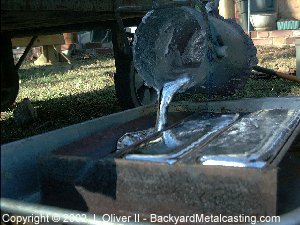
But truthers have many videos of them heating aluminium to the point of it glowing and showing it turn back to silver when they pour it, I hear you say. That’s true but they are missing one large factor, the volume. If you pour a small amount of aluminium, say 10g then it will cool down to the point it no longer glows within a relatively short distance. If you were to repeat the experiment with 100kg then it would take a considerably larger poring [sic] distance to cool down. The amount of material seen flowing from the world trade centre was a considerable volume and therefore it is not unexpected (if it was aluminium) for it to remain glowing.
First note that he
contradicts himself here, when saying that aluminum evidently can turn silver
instantly after leaving its container. What happened to “every metallurgist,
chemist, engineer etc.” saying just the opposite? But his explanation for the glowing
material is also problematic. Once again, he provides no reference to back up
his claim that the amount of metal makes any difference. Even if he were
correct, his whole point is moot anyway. The molten metal flowing out of the building
broke off into smaller droplets as it fell to the ground (which btw is exactly
what thermite reactions often look like), and yet the material still glowed.
Then we are told by Mr.
Power that we probably will never know for sure what the material was.
[W]as the molten material seen flowing from the world trade centre aluminium? The truth is we don’t know. The world is chaotic and sometimes no matter how hard people research something, sometimes some questions will always remain unanswered. The best explanation we have is that this molten material is aluminium from the airplane melted by the office fires, mixed with organic material, but we don’t 100% know. This is why I was very careful in the wording I used in my video “It is more than likely that the molten material seen flowing from the tower is aluminium”. I am very aware that I may be wrong but this does not mean that Adams [sic] nonsensical theories about thermite are correct. Any who this article is not really about what happened on September 11th, its [sic] about the apex truther and his willingness to ignore reality to stay secure and safe in his 9/11 conspiracy bubble.
It’s certainly shocking to
read these words written by someone who considers himself to be a scientist.
He’s apparently forgotten one of the prime factors of science that ensures that
it works: experimentation. Repeatable, verifiable experimentation. Debunkers
like him are making a specific argument; that aluminum heated up to a certain
temperature will behave in a certain way. This is a physical process, and can
therefore be repeated in the physical world. It may be that the material was
not aluminum, but Mr. Power cannot know this if he never even checks. To
somewhat quote Mr. Power, simply saying that something can do something is not
the same as proving that it can. One would need to try and recreate what
happened to know that for sure. Otherwise we only have Mr. Power’s word to fall
back on, which is far from actually conducting a scientific experiment.
However, others have done these kinds of experiments repeatedly, and those
experiments contradict the idea that the material was aluminum. Questions go
unanswered when people simply fail to address them, not because they can’t be
proven/disproven. Mr. Power can assert that I am ignoring reality all he wants,
but the facts demonstrate that it is he who is ignoring reality by ignoring the
experiments members of the Movement have carried out.
But it doesn’t end there.
Mr. Power also takes issue with my repeated attempts to show why he is wrong on
this issue.
After I posted his video on my Facebook wall Adam began commenting. In the comments section he was repeatedly confronted with testimony from people who work with molten aluminium, as well as video evidence posted from a guy named John. This video evidence proved without a shadow of doubt that aluminium can glow red/orange, that it continues to glow whilst being poured and whilst left standing for a certain period of time. Adams [sic] response when confronted with this overwhelming evidence was unbelievable and every one [sic] who was in the chat was flabbergasted by his response. I found myself with my mouth wide open and hands in the air screaming “WHAT!” in a mixture of confusion and anger.
“John, the videos you provide show aluminum glowing, but keep in mind that aluminum is highly reflective. The glow from the heat source is what is likely shown in the video. Especially the second, given that the aluminum is being poured in the evening. But once aluminum leaves its heat source and does not have any additional heat applied to it, it will turn silver almost instantly.” – Adam Taylor
I want you to take that in for a second. Adam is claiming that the light emitted by the molten aluminium in the videos is due to it being highly reflective and reflecting the glow from the heat source. For this to work molten aluminium must also have the ability to bend space and time to reflect light from a heat source which is not in direct line of sight into the camera, uniformly giving the impression that it is glowing. This was not a one off comment, as Adam was quizzed by others about his ludicrous claims and he repetitively said that the glow was due to it reflecting the heat source.
Once again, Mr. Power has
misrepresented what I was trying to convey. I asserted that the glow given off
in the videos provided showed that the light given off by the heat source was
reflected in the aluminum, and that is what caused it to glow. And Mr. Power
omits the fact that I had support on this assertion. My fellow blog contributor
ScootleRoyale (Scott Burnan) eventually stepped in and explained exactly what I
did, albeit in somewhat more technical terms.


Indeed, aluminum has low emissivity and very high reflectance, which is one of the reasons it’s used on mirrors. And ironically, the two pictures Mr. Power provides in his post do in
fact show the heat source directly near the “glowing” aluminum, not bending
space and time as he asserts.

Scootle also pointed out to Mr. Power that even
NIST doesn’t use his explanation for the molten material, instead asserting that it was molten aluminum mixed with organics. But as Scootle also showed,
this explanation has also been debunked by people in the Truth Movement. So
what the heck happened to Scootle’s arguments? Mr. Power acts as though it was
only me making such arguments, which is clearly wrong. It’s telling that he provides
no link to his thread on Facebook where this whole discussion took place. If
you’re on Facebook, you can read the discussion for yourself here.
(For more on why the
material could not have been molten aluminum, the following links are
recommended:
http://pilotsfor911truth.org/forum/lofiversion/index.php?t4749.html
http://911debunkers.blogspot.com/2009/02/debunking-molten-aluminium-flow-from.html)
http://pilotsfor911truth.org/forum/lofiversion/index.php?t4749.html
http://911debunkers.blogspot.com/2009/02/debunking-molten-aluminium-flow-from.html)
Finally, Mr. Power decides
to examine my credentials in relation to this discussion.
Now Adam admits that he has no scientific background but says he makes sure to carefully research any subject he is interested in. But you don’t have to have a science background to know this is wrong you just have to live in the real world. A lot of you may think that I am being unfairly harsh to Adam but remember he is not some anonymous troll on the internet. He writes for the debunking the debunkers blog and architects & engineers for 9/11 truth website, even though he is studying Liberal Arts and Political Science and not architecture or engineering. His delusions and arrogance are a product of 11 years of truther evolution. Evolution which has seen weaker truthers leaving the movement after been [sic] convinced by logic and evidence leaving apex truthers like Adam.
This whole dispute over my
qualifications and background is rather pointless. Regardless of what I have
academically studied (for the record, I actually did take architecture classes
in high school. I’m currently studying business and economics at my
university), I have made sure to read through the relevant literature and have
kept up to date with the science as much as I can. That is the whole point of
writing at the Debunking the Debunkers blog. We examine every argument from all
sides. It’s true that I am obviously an amateur in the technical sense, but the
lack of letters behind a person’s name does nothing to diminish the validity of
their work. My work is something that should be read and interacted with before
dismissing, and if Mr. Power thinks any differently, then it says more about
him than it does me. Contrary to what Mr. Power wants to believe about me, my
current beliefs about 9/11 are the result of over five years of careful
research and study, and also my determination to find out why almost 3000
people were murdered.

I believe that you are very misinformed
about the events of 9/11, and I will admit that some of that is likely due to
the truthers you’ve interacted with. As Scootle (Scott) pointed out to you on
Facebook, many truthers out there have not studied the events as carefully as
we have. That being said, you have still misrepresented the arguments presented
by accomplished scientists in the Movement, something that is not as excusable.
These scientists have done extraordinary work, and your arrogant dismissal of
them due to their involvement in the Truth Movement is simply nonsensical.
Obviously arguments over the internet don’t always accomplish much, but I do have an
alternate idea. It was recently suggested to me by a commenter on my blog that
you and I should have a real one on one debate regarding 9/11. And I think this
is a great idea. So if you are ever interested, I would be more than happy to
have a lively debate with you on the events of 9/11. How this would be set up
I’m not sure. I have connections with radio programs we could possibly appear
on. Or, if you have any ideas please feel free to let me know. In fact, you
yourself can be in charge of the whole thing if you wish. You can choose the
time, method, and format. You can even pick a moderator if you so choose. In
any event, I’m sure you are very busy producing your science videos, so I
wouldn’t expect this to be an instant thing. But if you are ever interested,
please let me know and I’m sure we can work something out.
9/11 is one of the most
important events that has ever happened in world history, and I hope you will
understand that I treat it as such. This issue is very important to me, and I
hope you are able to look past your pre-conceived notions regarding “conspiracy
theorists” and realize that all I am seeking is the truth. Part of this process
has involved me being skeptical of all sides of the arguments, even the
arguments from people in the Truth Movement. But I question if you have taken
the time to evaluate the claims made by those in authority, such as NIST, as
much as you have evaluated the claims of the Movement. To not do so represents
the very ugly side of skepticism, and I hope you have not fallen prey to that.
I hope that you will take my comments into consideration, and realize that I
care about science and the truth as much as you do.
Sincerely,
-Adam Taylor
Friday, January 18, 2013
"God in the Box" - A Fantastic Film
The documentary “God in the Box” is a fantastic film which explores
the wide range of different views on God that people have. We hear right from
the people themselves what God means to them and what kind of person they think
he is. It’s fascinating to hear so many different takes on God, both for and
against him. Also of note is that the film features scholar Acharya S., who
gives her expert insight into the development and characteristics of religion
and the concepts of God. It’s a wonderful film that, I think more than any
other, can be highly appreciated by both believers and non-believers alike.
Wednesday, January 16, 2013
Rebuttal to Myles Power - Molten Aluminum?
Related
Info:
Original
video: http://www.youtube.com/watch?v=GOSMpf6br1k
My
detailed response: http://adamtaylor42.blogspot.com/2012/12/taylor-contra-powers.html
(Also posted at the Debunking the Debunkers blog: http://911debunkers.blogspot.com/2012/12/taylor-contra-powers.html)
High
quality images: http://citizenfor911truth.files.wordpress.com/2013/01/moltenmetalwtc2-2.jpg
and http://citizenfor911truth.files.wordpress.com/2013/01/moltenmetalwtc2-1.jpg

My
article discussing molten aluminum: http://www.ae911truth.org/en/news-section/41-articles/653-debunking-the-real-911-myths-why-popular-mechanics-cant-face-up-to-reality-part-5-nanothermite-in-the-towers.html
Jerry
Lobdill’s article on molten aluminum: http://www.journalof911studies.com/letters/MoltenWhat2.pdf
Emissivity
and reflectance of aluminum: http://tinyurl.com/bx3o3nj
Thermite and Molten
Aluminum: http://pilotsfor911truth.org/forum/lofiversion/index.php?t4749.html
Debunking Molten Aluminum Flow from South Tower: http://911debunkers.blogspot.com/2009/02/debunking-molten-aluminium-flow-from.html
Debunking Molten Aluminum Flow from South Tower: http://911debunkers.blogspot.com/2009/02/debunking-molten-aluminium-flow-from.html
Sunday, January 13, 2013
Occupy Steubenville Protests, 12/29/2012 and 1/5/2013

Here’s video of the Occupy Steubenville protests I recorded on 12/29/2012 and 1/5/2013. They were both excellent, and showed what a strong passion for the truth the people in my town have. It was very inspiring. Again, please help to support this cause so that justice is served for the victim.
12/29/2012
1/5/2013
Occupy Steubenville 1/5/2013 from Adam Taylor on Vimeo.
See
also:
Background
info: http://localleaks.blogs.ru/2013/01/01/steubenvillefiles/
Flickr photos: http://www.flickr.com/groups/occupysteubenville/
Flickr photos: http://www.flickr.com/groups/occupysteubenville/
Tuesday, January 8, 2013
The Size and Structure of the Universe is More Consistent with Atheism than with Theism
Randal Rauser asks the question “Does the size of the universe support atheism or Christianity?” Specifically, the question
regards the debate over whether the size of the universe is more consistent
with the existence of some sort of deity who created it, or if it’s consistent
with the complete lack of a deity. According to Rauser, it all depends on how
you interpret the data. He writes:

 To carry this whole analogy over to the issue at
hand, the universe we observe is extremely large. How large? Essentially, the
universe is to the earth what the earth itself is to a speck of dust laying on
the floor. It’s that big. But it isn’t just that the universe is really, REALLY
big. It’s also that the vast majority of it is deadly to all living creatures.
This is a point strangely absent from Rauser’s post on the subject. It would be
one thing if the universe was just really big and didn’t have any life in it
except for earth-life. The other side to the issue is that most of the universe
(and I mean most, like 99.99999% of it) cannot support the life seen on earth,
which is obviously why there is no other life observable in it. Our universe is
like the hypothetical house with large amounts of mold growing throughout it.
And the earth is simply a rare area of the house that hasn’t yet been covered
in mold. I say “hasn’t yet” because at some point in the future the earth itself
will not be able to support life either. The problem is actually far worse than
my hypothetical scenario is making it out to be. For in my scenario, I describe
mold as being the threatening factor, which usually takes some time to take
full effect and do any real harm to you. But when it comes to the universe, we
know that kills you instantly. And we know this, again, because of past
experiences. Once we actually got up into space, it didn’t take us long to
realize “oh shit, we can’t survive out there.” And once we learned just how big
the universe really is, it didn’t take us long to realize “holy shit, there’s a
TON of universe we can’t survive in!”
To carry this whole analogy over to the issue at
hand, the universe we observe is extremely large. How large? Essentially, the
universe is to the earth what the earth itself is to a speck of dust laying on
the floor. It’s that big. But it isn’t just that the universe is really, REALLY
big. It’s also that the vast majority of it is deadly to all living creatures.
This is a point strangely absent from Rauser’s post on the subject. It would be
one thing if the universe was just really big and didn’t have any life in it
except for earth-life. The other side to the issue is that most of the universe
(and I mean most, like 99.99999% of it) cannot support the life seen on earth,
which is obviously why there is no other life observable in it. Our universe is
like the hypothetical house with large amounts of mold growing throughout it.
And the earth is simply a rare area of the house that hasn’t yet been covered
in mold. I say “hasn’t yet” because at some point in the future the earth itself
will not be able to support life either. The problem is actually far worse than
my hypothetical scenario is making it out to be. For in my scenario, I describe
mold as being the threatening factor, which usually takes some time to take
full effect and do any real harm to you. But when it comes to the universe, we
know that kills you instantly. And we know this, again, because of past
experiences. Once we actually got up into space, it didn’t take us long to
realize “oh shit, we can’t survive out there.” And once we learned just how big
the universe really is, it didn’t take us long to realize “holy shit, there’s a
TON of universe we can’t survive in!” Logically, the smaller the area of mold-free
house you find, the less likely you are to conclude that it was intentionally
put there for the house to sustain. If the area of mold-free house were
instead, say, as large as an entire wall, then you might conclude that someone
has taken the time to clean that section for some reason. If the area were,
say, the size of a baseball, you would find it even less likely someone was
specifically cleaning that area for a purpose. If instead the area was so small
that a penny turned sideways was just able to slide through and fit into it,
then you would be certain that that area was not specifically made to exist
there by anyone. That is what logically would make the most sense. And that is
exactly what we see in the case of the earth in relation to the rest of the
universe. This is not committing the “pale blue dot fallacy,” as Rauser asserts
in another of his posts on the topic. It’s looking at things in full
perspective. If you actually would argue that an extremely small mold-free area
of a house was specifically made that way by someone, why would you believe
that? If you offer a reason for believing that, then your reason had better be
testable, something we can check. If we can’t, then it follows that your reason
is totally ad hoc, and only serves to explain away the far more likely
scenario, that it just happens to be a rare area of the house that the mold
hasn’t yet covered.
Logically, the smaller the area of mold-free
house you find, the less likely you are to conclude that it was intentionally
put there for the house to sustain. If the area of mold-free house were
instead, say, as large as an entire wall, then you might conclude that someone
has taken the time to clean that section for some reason. If the area were,
say, the size of a baseball, you would find it even less likely someone was
specifically cleaning that area for a purpose. If instead the area was so small
that a penny turned sideways was just able to slide through and fit into it,
then you would be certain that that area was not specifically made to exist
there by anyone. That is what logically would make the most sense. And that is
exactly what we see in the case of the earth in relation to the rest of the
universe. This is not committing the “pale blue dot fallacy,” as Rauser asserts
in another of his posts on the topic. It’s looking at things in full
perspective. If you actually would argue that an extremely small mold-free area
of a house was specifically made that way by someone, why would you believe
that? If you offer a reason for believing that, then your reason had better be
testable, something we can check. If we can’t, then it follows that your reason
is totally ad hoc, and only serves to explain away the far more likely
scenario, that it just happens to be a rare area of the house that the mold
hasn’t yet covered. Likewise, if you believe that God had some
reason for creating a universe this big and making only one extremely small
area of it capable of sustaining life, then why would you believe that? Again,
you can offer a reason, but it had better be testable and checkable. Otherwise,
that reason will also be purely ad hoc, and only serve to explain away the
evidence which points toward the idea that there is no God. Rauser himself
briefly gives an ad hoc assumption for why God would make the universe this
way; "there could be a creator God who doesn’t care about us." Of
course, this scenario is certainly possible. I have no way to prove it’s not.
But what we should ask is if this scenario is probable. I’m always baffled by
theists who consider the possibility that God simply doesn’t care about us. If
that were true, then why would God bother making us in the first place? Now
Rauser obviously doesn’t think this is the case. I’m sure he thinks God cares
about us very much. He only considers the idea that God is indifferent to us as
a possibility. But that’s the point. It’s only a possibility that’s conveniently
put out there as an alternative scenario, relying on ad hoc assumptions. But,
if there was in fact no God, then we wouldn’t need to invent any ad hoc
assumptions to explain why the universe appears indifferent to us. The reason
the universe doesn’t care about us is the same reason a rock doesn’t care about
us. Or that a speck of dust doesn’t care about us. Or that the computer keys
I’m typing on at this very moment don’t care about us. They all lack any sort
of conscious cognitive functions. No intelligence, no feelings, no agendas.
Nothing. The universe behaves exactly the way we would expect it to behave if
there was absolutely no intelligence behind it at all.
Likewise, if you believe that God had some
reason for creating a universe this big and making only one extremely small
area of it capable of sustaining life, then why would you believe that? Again,
you can offer a reason, but it had better be testable and checkable. Otherwise,
that reason will also be purely ad hoc, and only serve to explain away the
evidence which points toward the idea that there is no God. Rauser himself
briefly gives an ad hoc assumption for why God would make the universe this
way; "there could be a creator God who doesn’t care about us." Of
course, this scenario is certainly possible. I have no way to prove it’s not.
But what we should ask is if this scenario is probable. I’m always baffled by
theists who consider the possibility that God simply doesn’t care about us. If
that were true, then why would God bother making us in the first place? Now
Rauser obviously doesn’t think this is the case. I’m sure he thinks God cares
about us very much. He only considers the idea that God is indifferent to us as
a possibility. But that’s the point. It’s only a possibility that’s conveniently
put out there as an alternative scenario, relying on ad hoc assumptions. But,
if there was in fact no God, then we wouldn’t need to invent any ad hoc
assumptions to explain why the universe appears indifferent to us. The reason
the universe doesn’t care about us is the same reason a rock doesn’t care about
us. Or that a speck of dust doesn’t care about us. Or that the computer keys
I’m typing on at this very moment don’t care about us. They all lack any sort
of conscious cognitive functions. No intelligence, no feelings, no agendas.
Nothing. The universe behaves exactly the way we would expect it to behave if
there was absolutely no intelligence behind it at all.
“…Is the atheist right
to think the universe says we’re not special? Or is the Christian right to
think it shows that God is great?” The answer is both and neither. In other
words, if you begin with atheistic assumptions then you will predictably (but
not necessarily) draw the conclusion that the size of the universe supports
atheism. If you start with Christian assumptions then you will predictably (but
not necessarily) draw the conclusion that the size of the universe supports
Christian theism.
So both.
And as I said, also
neither. Given that different presuppositions can interpret the data
differently we have good reason to believe that the data itself underdetermines
its own interpretation. Simply learning that the universe is vastly large and
that there are huge objects within it doesn’t provide any evidence in and of
itself either for atheism or (Christian) theism. The evidence, such as it is,
awaits interpretation relative to a set of presuppositions.

I, of course, am an atheist, and I believe that
the size of the universe is consistent with the idea that there is no God and
that we are not special. But do I only believe that because I’m an atheist? Is
that the only way I can interpret the universe due to my presuppositions? It’s
true that it can be hard to separate our biases at times. However, I have found
that one useful way for us to overcome these biases is to imagine another
scenario—completely independent of the issue at hand—that is similar enough to
the present issue, and make similar determinations. With that said, let me
present a scenario that we can make judgments about. Let us say, for the sake
of discussion, that we come across a house, whose interior is almost completely
covered in mold. Virtually every inch of the house’s interior is covered in
slimy, greenish-gray mold that shows no signs of going away anytime soon. This
mold is also very toxic, and prolonged exposure to it is very deadly and can
potentially kill you. But looking throughout the house, you come across one
tiny section of a wall that seems to have no mold covering it. The amount of
wall not covered in mold is roughly the size of your thumb.
Now, based on these facts, here’s the question I
would pose regarding this small area of mold-free wall: Was this house
intentionally designed to produce this enormous amount of mold so that only
this tiny area could exist mold-free? Or, is it more likely that the mold
simply grew throughout the house due to the lack of any human care, and that by
chance we find a lucky area of the house not covered in mold?
Now I would say the latter scenario makes more
sense. But how do I come to that conclusion? Well for starters, we would know
from previous experiences that houses that contain this level of mold usually
only get that way because of insufficient care by the owners, or if the house
is simply abandoned and no care is given at all. While it is certainly possible
that the owners might deliberately plant this mold within their house, this is
usually never the case. The scenario that we find happens far more often is
that the house simply is not taken care of.
But why wouldn’t anyone want to plant mold
throughout their home? As we established, mold can be very unhealthy and has
the potential to kill people who are exposed to it for prolonged periods of
time.
But how do we know the mold is deadly to begin
with? Obviously we would need to see cases where mold caused health problems in
living creatures. Once any living creature was eventually exposed to this, and
once the effects of this prolonged exposure were observed and documented, it
wouldn’t take long to realize that this mold is harmful and we want to avoid it
as much as possible.
It should be noted that up to this point, the
factor of a presupposed worldview has not come into play at all. It has simply
been about establishing what the facts are, and drawing inferences from those
facts that logically make sense. So here are the established facts:
Premise A: We know that mold can be very
unhealthy to living creatures that are exposed to it for prolonged periods of
time (an assessment made only after seeing previous instances of this
happening).
Premise B: People would not normally plant mold
intentionally throughout their home, due to the reasons given in Premise A.
Premise C: Therefore, when mold is seen to be
growing throughout a house, we know that it is far more likely because the
house either has insufficient care by the owners, or the house is abandoned and
therefore has no care at all.
Premise D: If we find a small area of the house
that is not covered in mold, we would not come to the conclusion that this
house was made to support this one small area, due to the reasons given in the
previous premises. It is far more likely that this is just a lucky area of the
house that has not yet been covered in mold.
QED
(I hope I haven’t bored you with all this. I
promise there is a point I am making here.)
 To carry this whole analogy over to the issue at
hand, the universe we observe is extremely large. How large? Essentially, the
universe is to the earth what the earth itself is to a speck of dust laying on
the floor. It’s that big. But it isn’t just that the universe is really, REALLY
big. It’s also that the vast majority of it is deadly to all living creatures.
This is a point strangely absent from Rauser’s post on the subject. It would be
one thing if the universe was just really big and didn’t have any life in it
except for earth-life. The other side to the issue is that most of the universe
(and I mean most, like 99.99999% of it) cannot support the life seen on earth,
which is obviously why there is no other life observable in it. Our universe is
like the hypothetical house with large amounts of mold growing throughout it.
And the earth is simply a rare area of the house that hasn’t yet been covered
in mold. I say “hasn’t yet” because at some point in the future the earth itself
will not be able to support life either. The problem is actually far worse than
my hypothetical scenario is making it out to be. For in my scenario, I describe
mold as being the threatening factor, which usually takes some time to take
full effect and do any real harm to you. But when it comes to the universe, we
know that kills you instantly. And we know this, again, because of past
experiences. Once we actually got up into space, it didn’t take us long to
realize “oh shit, we can’t survive out there.” And once we learned just how big
the universe really is, it didn’t take us long to realize “holy shit, there’s a
TON of universe we can’t survive in!”
To carry this whole analogy over to the issue at
hand, the universe we observe is extremely large. How large? Essentially, the
universe is to the earth what the earth itself is to a speck of dust laying on
the floor. It’s that big. But it isn’t just that the universe is really, REALLY
big. It’s also that the vast majority of it is deadly to all living creatures.
This is a point strangely absent from Rauser’s post on the subject. It would be
one thing if the universe was just really big and didn’t have any life in it
except for earth-life. The other side to the issue is that most of the universe
(and I mean most, like 99.99999% of it) cannot support the life seen on earth,
which is obviously why there is no other life observable in it. Our universe is
like the hypothetical house with large amounts of mold growing throughout it.
And the earth is simply a rare area of the house that hasn’t yet been covered
in mold. I say “hasn’t yet” because at some point in the future the earth itself
will not be able to support life either. The problem is actually far worse than
my hypothetical scenario is making it out to be. For in my scenario, I describe
mold as being the threatening factor, which usually takes some time to take
full effect and do any real harm to you. But when it comes to the universe, we
know that kills you instantly. And we know this, again, because of past
experiences. Once we actually got up into space, it didn’t take us long to
realize “oh shit, we can’t survive out there.” And once we learned just how big
the universe really is, it didn’t take us long to realize “holy shit, there’s a
TON of universe we can’t survive in!”
I also described the area of mold-free house as
being roughly the size of your thumb. But in ratio to the whole universe, the
earth is even smaller than that. Richard Carrier himself notes this point,
writing that:
A universe perfectly
designed for life would easily, readily, and abundantly produce and sustain it.
Most of the contents of that universe would be conducive to life or benefit
life. Yet that is not what we see. Instead, almost the entire universe is
lethal to life—in fact, if we put all the lethal vacuum of outer space swamped
with deadly radiation into an area the size of a house, you would never find
the comparably microscopic speck of area that sustains life. Would you conclude
that the house was built to serve and benefit that subatomic speck? Hardly. Yet
that is the house we live in. The Christian theory completely fails to predict
this—while atheism predicts exactly this.
Logically, the smaller the area of mold-free
house you find, the less likely you are to conclude that it was intentionally
put there for the house to sustain. If the area of mold-free house were
instead, say, as large as an entire wall, then you might conclude that someone
has taken the time to clean that section for some reason. If the area were,
say, the size of a baseball, you would find it even less likely someone was
specifically cleaning that area for a purpose. If instead the area was so small
that a penny turned sideways was just able to slide through and fit into it,
then you would be certain that that area was not specifically made to exist
there by anyone. That is what logically would make the most sense. And that is
exactly what we see in the case of the earth in relation to the rest of the
universe. This is not committing the “pale blue dot fallacy,” as Rauser asserts
in another of his posts on the topic. It’s looking at things in full
perspective. If you actually would argue that an extremely small mold-free area
of a house was specifically made that way by someone, why would you believe
that? If you offer a reason for believing that, then your reason had better be
testable, something we can check. If we can’t, then it follows that your reason
is totally ad hoc, and only serves to explain away the far more likely
scenario, that it just happens to be a rare area of the house that the mold
hasn’t yet covered. Likewise, if you believe that God had some
reason for creating a universe this big and making only one extremely small
area of it capable of sustaining life, then why would you believe that? Again,
you can offer a reason, but it had better be testable and checkable. Otherwise,
that reason will also be purely ad hoc, and only serve to explain away the
evidence which points toward the idea that there is no God. Rauser himself
briefly gives an ad hoc assumption for why God would make the universe this
way; "there could be a creator God who doesn’t care about us." Of
course, this scenario is certainly possible. I have no way to prove it’s not.
But what we should ask is if this scenario is probable. I’m always baffled by
theists who consider the possibility that God simply doesn’t care about us. If
that were true, then why would God bother making us in the first place? Now
Rauser obviously doesn’t think this is the case. I’m sure he thinks God cares
about us very much. He only considers the idea that God is indifferent to us as
a possibility. But that’s the point. It’s only a possibility that’s conveniently
put out there as an alternative scenario, relying on ad hoc assumptions. But,
if there was in fact no God, then we wouldn’t need to invent any ad hoc
assumptions to explain why the universe appears indifferent to us. The reason
the universe doesn’t care about us is the same reason a rock doesn’t care about
us. Or that a speck of dust doesn’t care about us. Or that the computer keys
I’m typing on at this very moment don’t care about us. They all lack any sort
of conscious cognitive functions. No intelligence, no feelings, no agendas.
Nothing. The universe behaves exactly the way we would expect it to behave if
there was absolutely no intelligence behind it at all.
Likewise, if you believe that God had some
reason for creating a universe this big and making only one extremely small
area of it capable of sustaining life, then why would you believe that? Again,
you can offer a reason, but it had better be testable and checkable. Otherwise,
that reason will also be purely ad hoc, and only serve to explain away the
evidence which points toward the idea that there is no God. Rauser himself
briefly gives an ad hoc assumption for why God would make the universe this
way; "there could be a creator God who doesn’t care about us." Of
course, this scenario is certainly possible. I have no way to prove it’s not.
But what we should ask is if this scenario is probable. I’m always baffled by
theists who consider the possibility that God simply doesn’t care about us. If
that were true, then why would God bother making us in the first place? Now
Rauser obviously doesn’t think this is the case. I’m sure he thinks God cares
about us very much. He only considers the idea that God is indifferent to us as
a possibility. But that’s the point. It’s only a possibility that’s conveniently
put out there as an alternative scenario, relying on ad hoc assumptions. But,
if there was in fact no God, then we wouldn’t need to invent any ad hoc
assumptions to explain why the universe appears indifferent to us. The reason
the universe doesn’t care about us is the same reason a rock doesn’t care about
us. Or that a speck of dust doesn’t care about us. Or that the computer keys
I’m typing on at this very moment don’t care about us. They all lack any sort
of conscious cognitive functions. No intelligence, no feelings, no agendas.
Nothing. The universe behaves exactly the way we would expect it to behave if
there was absolutely no intelligence behind it at all.
But that leaves open a very important question;
what would the universe look like if there was a God? I can think of two
scenarios:
1. The
universe wouldn’t be this big. There would only be one solar system, containing
the earth, moon and sun (and perhaps not even the moon, if God could make it so
that we wouldn’t need it in the first place). This would make total sense on
the assumption that there is a God. He would only have us in mind, and
therefore would make a universe with only us in mind as well.
2. Or,
with the universe being the size it actually is, the vast majority of the
universe should have life in it. Life-bearing planets should be everywhere. For
if there is a point to the universe, why shouldn’t God use it to its full
potential?
Again, there obviously could be a reason why God
would make the universe the way it actually is. But no scenario I am aware of
has ever logically shown why that would be the case. However, if there was no
God, then this is exactly the kind of universe we would expect to see. So
unless you can show why God would go to the trouble of making the universe this
way (a way that, incidentally, looks the way it would have to look if nobody
designed it), then we simply have no reason to believe God or any other sort of
creator had a hand in creating it at all. Our planet is simply a tiny speck of
clean house that hasn’t yet been devoured by the deadly mold that spreads
throughout our home. I’m grateful that hasn’t happened yet, and I plan on
enjoying however much time I have left on earth.
The truth is simply inescapable: the kind of
universe we live in, given its size and structure, is more consistent with atheism
than with theism.
See also:
Subscribe to:
Posts (Atom)